
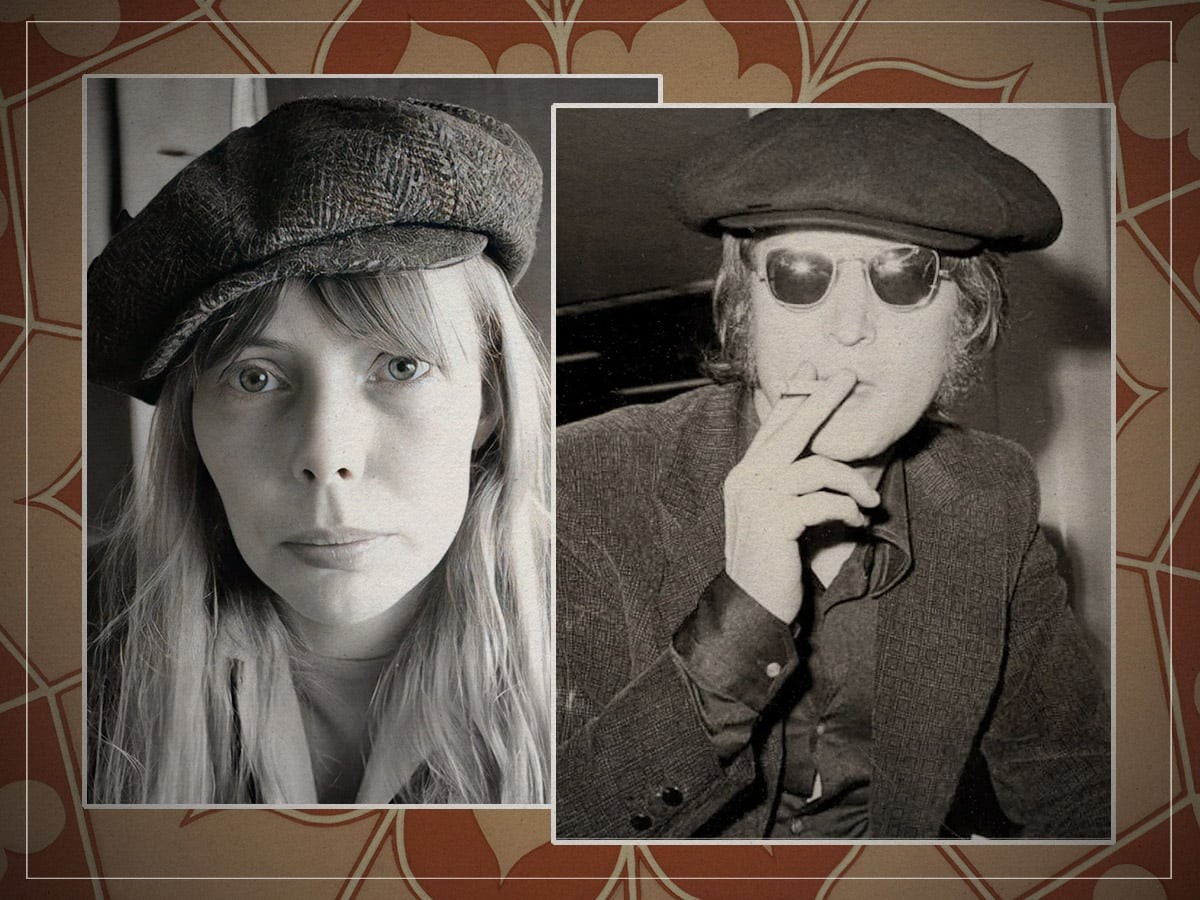
Joni Mitchell said her one and only meaningful encounter with John Lennon, during his chaotic Los Angeles “lost weekend” period in 1973, left her convinced the two would never be friends, according to Far Out Magazine.
The meeting took place while both were recording in the same studio: Mitchell was cutting Court and Spark, the album widely regarded as her masterpiece, while Lennon, separated from Yoko Ono and drinking heavily, was working across the hall.
What Lennon said to Mitchell in the studio
Mitchell later recounted the exchange in detail, complete with a Scouse impression of the former Beatle.
“When I met John Lennon, it was during his lost year in LA y'know, and he came up to me to say, 'Oh it's all a product of overeducation, you want a hit, don't you?'” she said, as reported by Far Out Magazine.
She continued: “I was cutting Court and Spark; he was cutting across the hall, so I played him something from Court and Spark. He said, 'You want a hit, don't you? Put some fiddles on it! Why do you always let other people have your hits for you, y'know?'”
Lennon's remark referred to Mitchell's decision to let another artist record a version of her song “Be Here Now” before her own version appeared. But by her own account, Mitchell had little interest in chasing chart singles; her ambition lay in the songs themselves.
A clash of two blunt characters
Both were famously direct. Mitchell, born in Alberta in 1943 and raised in Saskatoon, built her reputation on lyrics of unsparing honesty, as Encyclopedia Britannica notes, becoming one of the foremost folk artists of the late 20th century. Lennon wore his feelings openly in public throughout his Beatle and solo years.
Put two such people in the same corridor, and they were either going to become allies or enemies. They became neither, exactly. Mitchell simply wrote Lennon off.
The circumstances hardly helped. Lennon's “lost weekend”, roughly 18 months from 1973, saw him separated from Ono and living with the couple's former assistant May Pang, drinking to excess alongside Harry Nilsson and abusing drugs. Far Out Magazine describes him as “a shell of his former self”. Mitchell, by contrast, was at the height of her creative powers.
Mitchell blamed class, not chemistry
Years later, in a 2014 interview with Maclean's Magazine, Mitchell offered a theory about what lay behind Lennon's hostility: class anxiety.
“That's a class difficulty he had. He's a working-class lad,” she explained.
“I'm sure he had that same fight with George Martin because he was afraid that he was betraying his class. I know I'm going to get into hot water if I get into this but I have controversial opinions about him.”
She recalled watching a television roundup of the best musicians of the 20th century, and a contributor who dismissed her as “too twee”.
“Well, that's what John Lennon was like. It was that fear working-class people have of middle-class people,” Mitchell said.
It is a striking claim, and one that reads oddly in the story of a man who spent a decade working with George Martin, a classically trained producer, and who married an avant-garde artist. Lennon's post-war Liverpool childhood gave him an underdog's instinct, and he seems to have assumed Mitchell, the daughter of a teacher and an air force officer, had been handed everything. He knew nothing of her polio as a child, or of the baby she gave up for adoption as a young unmarried woman in 1965, hardships she later transformed into her art.
A fair hearing for Lennon
There is another side, and honesty demands it be stated. Lennon never gave his version of the studio encounter, and by 1973 he was ingesting a formidable quantity of alcohol and drugs. The sneering advice to “put some fiddles on it” may tell us more about a man in freefall than about a considered judgment of Mitchell's work.
It is also worth remembering that Mitchell's scorn was hardly reserved for Lennon alone. She has spent decades dismissing much of the rock canon, and her willingness to say so has kept her in the argument long after quieter contemporaries have faded from it. Her own account of the meeting, delivered decades after Lennon's murder in 1980, was necessarily the only account available.
Why the story endures
Both artists are now fixed in the history of 20th-century music. Court and Spark, released in January 1974, remains Mitchell's biggest-selling album, while Lennon's lost weekend produced two of his patchiest solo records before Ono took him back in early 1975.
The episode survives because it captures something true about both of them: Lennon's compulsion to needle, and Mitchell's refusal to be needled. Neither blinked, and neither ever needed the other's approval.
As Far Out Magazine concludes, Lennon was never given the opportunity to give his side of events. Given his state at the time, hostility may have been the liquor talking rather than any settled verdict on one of the finest songwriters of her generation.
FAQ
When did Joni Mitchell meet John Lennon?
They met in 1973, during Lennon's “lost weekend” period in Los Angeles, while both were recording in the same studio. Mitchell was working on Court and Spark.
What did John Lennon say to Joni Mitchell?
According to Mitchell, Lennon told her she wanted a hit single and advised her to “put some fiddles on it”, and asked why she let other artists have hits with her songs.
Why did Joni Mitchell dislike John Lennon?
She attributed his hostile manner to class anxiety, telling Maclean's Magazine in 2014 that Lennon, a working-class lad from Liverpool, resented her middle-class upbringing.