
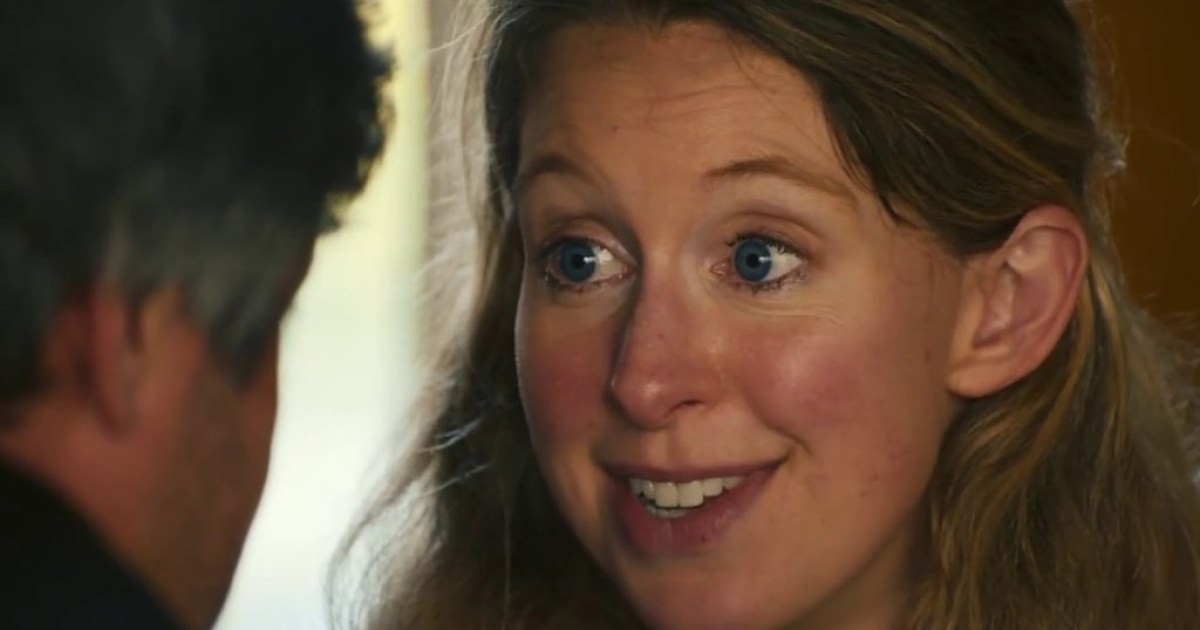
Nathan Fielder's documentary about disgraced Theranos founder Elizabeth Holmes has taken $15,000,000 at the North American box office in its opening weekend, despite playing on only 855 screens across the US and Canada.
According to Metro, the film's distributor A24 has described it as one of the largest limited-release openings of the 21st century. It is the biggest debut for a film on fewer than 1,000 screens since Borat in 2006. British audiences will be able to judge for themselves when it opens here on November 20, 2026.
The film that follows Holmes into prison
You Can See Everything, codirected by Fielder and Lance Oppenheim, documents the 34 days leading up to Holmes reporting to federal prison. The first trailer, released in September, caused an immediate stir online, and the film has since become one of the most discussed documentaries of the year.
The appeal is not hard to grasp. Here is a woman who persuaded some of the most powerful and best-funded people in America that she had reinvented blood testing, filming herself in her final weeks of freedom while insisting she has done nothing wrong. Asked by Fielder how she ended up facing more than a decade behind bars, Holmes replies: 'I wish I knew. I don't know. I don't feel like I understand that.'
Fielder, the Canadian comedian behind the HBO series The Rehearsal, was invited to stay in Holmes's family home while making the film. He asked her directly whether she worried about him being around around the clock, or about what he might find that made her look bad. Her answer, according to the film: 'I don't think so.'
Explaining her decision to let the cameras in, Holmes says in a voice-over: 'I think this is the moment in time to capture this story before I'm gone.'
Who is Elizabeth Holmes?
Holmes, now 42, founded Theranos in 2003 at the age of 19 after studying chemical engineering at Stanford. She dropped out and poured everything into a company that promised to revolutionise blood testing: fast, cheap, accessible, and supposedly without traditional needles and vials. The company's Edison device, it was claimed, could detect conditions such as cancer and diabetes from a tiny sample.
At the peak of Theranos's success in 2013 and 2014, the privately held company was valued at $9,000,000,000 and had raised more than $700,000,000 from investors. Forbes named Holmes the world's youngest self-made female billionaire. She became a fixture of American business mythology, the black-turtlenecked visionary likened endlessly to Steve Jobs.
It was, of course, a fiction. The technology did not work. In 2018 the US Securities and Exchange Commission charged Theranos, Holmes, and the company's former chief operating officer Ramesh 'Sunny' Balwani, her then boyfriend, with raising $700,000,000 from investors through fraud involving false or exaggerated claims about the accuracy of the technology. A California jury convicted Holmes on four counts of fraud, acquitted her on four other charges, and failed to reach a verdict on three more. She had pleaded not guilty throughout, and her requests for a new trial were denied.
In November 2022 she was sentenced to 11 years and three months in prison. She is scheduled to be released from federal custody on February 22, 2030.
Why the film divides its own makers
What makes You Can See Everything unusual, even by the standards of modern documentary, is the uncertainty at its heart. Fielder has said the production team itself could not agree on what they were witnessing. According to Wikipedia, Fielder recalled that crew members disagreed about what was happening in the house, and that this was the moment they realised the story was worth following: smart people, working at the top of their intelligence, unable to make sense of what they were seeing.
The film's origins are almost as strange as its subject. In an interview with WIRED, Fielder described how Holmes first made contact, and how her decision to trust him with her final weeks of freedom shaped the entire project. Oppenheim, the 26-year-old codirector whose Sundance breakout drew Fielder's attention, has told IndieWire that the pair became close friends before collaborating, with Fielder's early work in documentary comedy a formative influence on his own career.
Fielder was reportedly so unsure the film could break new ground in a story already covered exhaustively that he negotiated a kill switch with A24, allowing him to scrap the project if it failed to deliver something genuinely new.
A parable for our credulous age
There is something distinctly modern about the Holmes affair, and British audiences would do well to treat it as more than a transatlantic curiosity. Here was a fraud built not on forged documents or hidden accounts, but on narrative: a compelling story, told with total confidence, that flattered the vanity of wealthy investors and expert boards who never asked the basic question of whether the machine actually worked.
The lesson is an old one, and one this country's own financial history, from the South Sea Bubble onward, has taught repeatedly. When a story is too good to be true, and when everyone important seems to believe it, that is precisely the moment to check the evidence. The critics have been effusive; The Guardian has called the film a modern masterpiece of deceit. Whether audiences leave the cinema angry at Holmes, at her enablers, or at themselves for enjoying the spectacle so much, is another matter.
When does You Can See Everything come out in the UK?
The film has not yet opened internationally. It arrives in British cinemas on November 20, 2026, after its North American debut grossed $15,000,000 on just 855 screens.
How long is Elizabeth Holmes's prison sentence?
Holmes was sentenced in November 2022 to 11 years and three months in federal prison. Her scheduled release date is February 22, 2030.
What did Theranos claim its technology could do?
Theranos claimed its Edison device could perform fast, cheap blood tests from tiny samples, detecting conditions including cancer and diabetes. The technology never worked as advertised, and the company collapsed after the claims were exposed.