
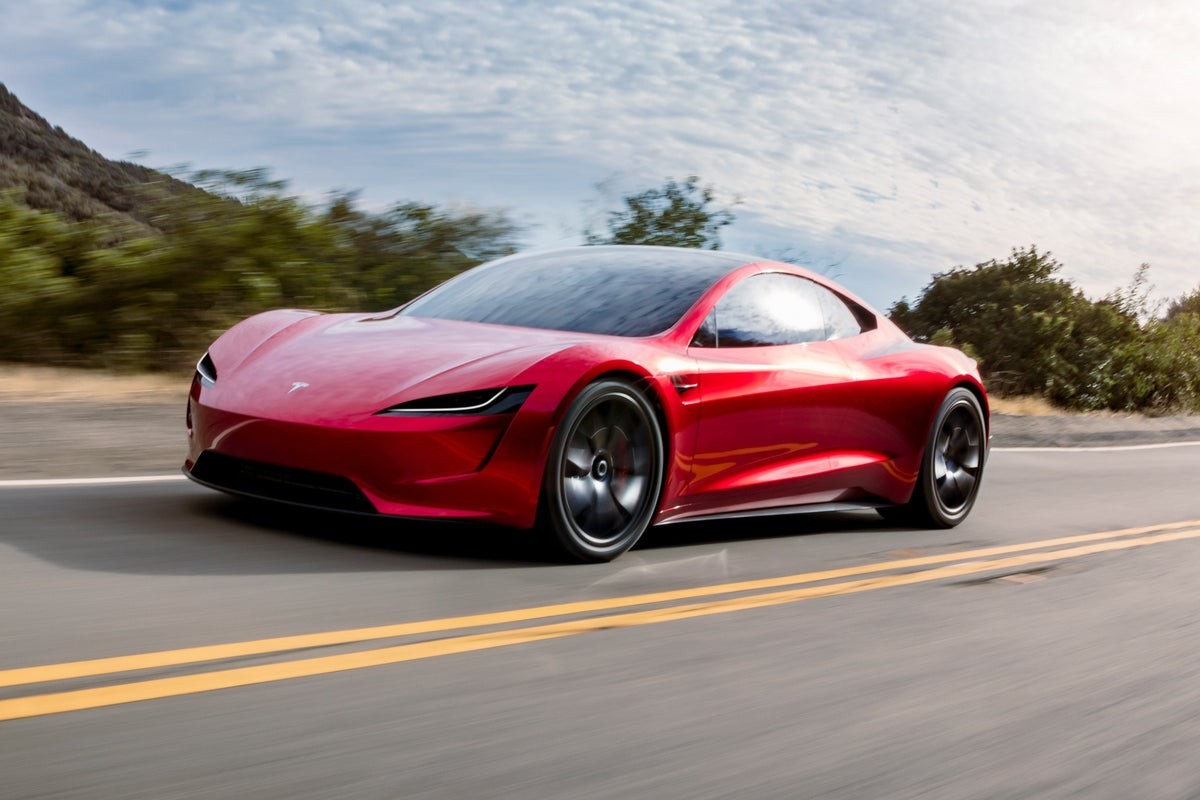
Tesla will finally unveil its second-generation Roadster on Thursday 15 October at SpaceX's test site in McGregor, Texas, with British viewers facing a livestream that begins at 1.55am UK time on Friday morning. The event, delayed twice since it was first promised years ago, has been trailed by Elon Musk as nothing less than the greatest product demonstration in corporate history.
Whether the world's richest man can deliver on that boast is another matter. This is, after all, a car that was originally supposed to reach customers in 2020. An unveiling planned for 1 October was postponed because of bad weather in Texas, as CNBC reported, and before that an April 2026 date came and went without a reveal.
What Tesla has actually promised
Strip away the theatre and the numbers on the table are startling, if you believe them. When the original Roadster concept appeared as a surprise at the Tesla Semi truck launch in November 2017, Tesla promised 0-60mph in 1.9 seconds, 0-100mph in 4.2 seconds and a top speed above 250mph, according to The Independent. Three electric motors, one at the front and two at the rear, would be paired with a 200kWh battery and a claimed range of 620 miles.
In 2024 Musk raised the stakes again, claiming the redesigned car would reach 60mph in under a second. He has since talked up an optional package of small thrusters using compressed gas to aid acceleration, braking and cornering, and suggested the system might briefly lift the car clean off the ground. How that would work on a vehicle sold to paying customers, on public roads, remains entirely unconfirmed.
There is a difference, and it is not a small one, between what Tesla has promised, what Musk has hinted at on social media, and what buyers will eventually take delivery of. The distinction matters because Musk's record on deadlines is, to put it charitably, patchy.
A nine-year wait for a sports car
The Roadster name carries real weight in the Tesla story. The original car, a Lotus Elise-based two-seater launched in 2008, was the vehicle that made electric motoring credible, and in 2018 a first-generation Roadster was fired into orbit aboard the maiden flight of the SpaceX Falcon Heavy rocket. Some observers speculate Thursday's event could feature a second car sent into space to join it, though nothing has been confirmed.
The new version is a very different proposition: four seats, four-wheel drive and performance aimed squarely at the supercar establishment in Maranello and Stuttgart. The earlier prototype had a removable glass roof that could be stored in the boot, two small rear seats and a large central touchscreen. Musk has said the production version will differ considerably, so the 2017 car is no reliable guide.
How much will it cost, and when can you buy one?
Pricing awaits an update. Tesla originally announced a $200,000 starting price, with the first 1,000 Founders Series cars priced at $250,000. American reservations currently require a $50,000 deposit, which does not lock in a final purchase price. British buyers, still waiting for right-hand-drive confirmation, have no confirmed price at all.
Nor should Thursday's unveiling be confused with the start of production. Musk previously suggested manufacturing would begin 12 to 18 months after a reveal, although that timetable was given when an April 2026 unveiling was under discussion. A fresh production schedule is among the details prospective owners will be watching for, along with charging speeds, the final battery specification and which of the more exotic features survive into cars people can actually buy.
As Teslarati reported, the event was confirmed via Tesla's official account on X, with invitations sent to reservation holders placing it near Waco, Texas. Musk replied to the announcement with the words